Slipway Peter Shear

If there is a sense of reality, there must also be a sense of possibility.
– Robert Musil, The Man Without Qualities, 1930 – 1942
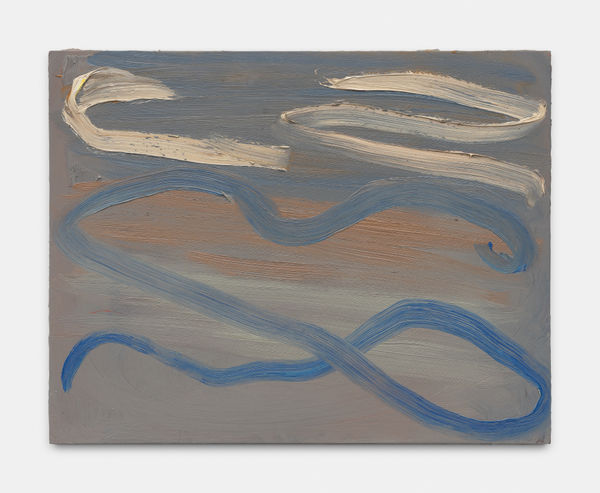
Mendes Wood DM is pleased to announce Slipway, Indiana-based painter Peter Shear’s first European solo exhibition. Shear is best known for small-format canvases that resist classification, fixed formulae, or repetition. As a painter, he has staked out a position that uncouples abstract painting from the inheritance of established idioms, offering an exploratory approach and an alternative to dogma and orthodoxy. Working with essentials – planes of color, schematic marks, loosely defined shapes, provisional geometries – his paintings inhabit the space between abstraction and legibility, suspending recognition without resolving it. His brushwork shifts from thick to feathery to dry, while grounds may be flat, stained, built up in layers, or left exposed. “Drawing in paint” is central to the practice – as is observing works from a distance, returning over time to work through compositional tensions. Without yielding to overt “pattern seeking” or insistent “expressionism,” the works draw viewers close through an economy of means. In this regard, Shear shares ground with painters like Thomas Nozkowski, Raoul de Keyser, and Ilse D’Hollander, artists who turned away from grand gestures toward quieter, more searching engagements with the medium.
For Shear, a work succeeds when it escapes intention, when it surprises, unsettles, or resists. “Finished paintings” carry an element of doubt, something slightly off or lopsided. Colors muddy. Compositions tilt, occlude, or stall. Some works are kinetic, offering a breath of air or a sense of release from set compositions. Others remain unaccommodating, even sour. Each one occupies an unstable intersection of meanings without telegraphing any single reading. Reading and the mechanics of literary production are adjacent to Shear’s practice. The artist, who cites elliptical poets such as Emily Dickinson and John Ashbery as touchstones, describes a slippage between how a painting comes into being and when it is set aside. At times, the works serve as prologues or armature for something. Often, they present themselves like a minimalist poem, sometimes a short story, functioning like essays in the etymological sense of an attempt, a trial, a working through.
Variously, Shear’s practice aligns with what Robert Musil, the singular novelist of life as experiment, called “essayism” – a mode of thinking that embraces tentativeness, possibility, and openness. In the spirit of The Man Without Qualities (1930 – 1942), whose central character remains open to possibility through his refusal of fixed beliefs, Shear’s canvases persist as fragments – passionate, piecemeal, unresolved. Where audiences often expect closure and meaning; the paintings hold precisely because they don’t resolve.
Moving in and out of harmony, the works presented in the exhibition demonstrate how range itself becomes a method. In the titular Slipway (2025), olive greens and deep browns are laid down in broad horizontal sweeps, areas scraped back to reveal underlayers, evoking erosion or tidal residue while remaining insistently planar. Valve (2025) moves differently, with thick diagonal strokes of gray establishing a mechanical rhythm as vivid ultramarine presses in from the edges like contained pressure. Bold shapes cluster near the center of a cerulean field in Scan (2025), almost pictographic, as if decocted to essential graphic components – while titles elsewhere gesture toward encounter, toy lightly with the viewer, as in Touch (2025), where organic curvatures hint at anatomy, the word lending intimacy to the forms. In Procession (2025), one of the more pared-down works in the group exhibited, violet marks cascade down a luminous ground, balancing studio discipline and happenstance.
Never proprietary of his images, Shear imagines an exhibition as a contraption, a device that poses questions: which moving parts can generate an effect, with what economy of means? As visitors move through the gallery, they carry the memory of geometries, a palette, a scale, a sensation. The paintings may appear dissonant or cacophonous, familiar or strange, capable of conjuring memories numinous or disturbing. If the essais presented in Slipway arrive through this process at something like completion, it is only in the experience of those who encounter them, finishing what Shear calls “the sentence.” What matters most is that in moving through fissures, dislodgings, resonances, viewers are left with fragments of a conversation.
Peter Shear (b. 1980, Beverly Farms, USA) lives and works in Bloomington.
Recent solo exhibitions include Slipway, Mendes Wood DM, Brussels (2026); The Company, Denison University, Granville (2026); A Point Between the Eyes, Mendes Wood DM, Germantown (2025); Accident Report, American Art Catalogs, New York (2024); Reality Show, Blum, Los Angeles (2024); Following Sea, Cheim & Read, New York (2023); The Cat Came Back, Castle, Los Angeles (2022); Peter Shear: Empty Boat, Koki Arts, Tokyo (2021); Recording, Fortnight Institute, New York (2021); Time Stamp, Herron School of Art + Design, Indiana University, Indianapolis (2019).
Recent group exhibitions include Surface and Signal, Blum, Tokyo (2025); Breath, Art Cake, Brooklyn (2025); Find and Keep: Janine Iversen and Peter Shear, CLEARING, New York (2024); The Wrong Tree, dunes.fyi, Portland (2024); The Feminine in Abstract Painting, Milton Resnick and Pat Passlof Foundation, New York (2023); Real Life, Sofie Van de Velde, Antwerp (2023); Things Seen, Make Room, Los Angeles (2023); A Game for the Living, dunes.fyi, Portland (2023); The Sense of Sight: Landscape, the City, and Abstraction, Make Room, Los Angeles (2023); Regarding Kimber, Cheim & Read, New York (2022); Small Paintings, Venus Over Manhattan, New York (2022); 10 Year Anniversary Exhibition, Koki Arts, Tokyo (2022); Beyond Genres, Outsider Art Fair, New York (2022); Angle of Repose, Poker Flats Gallery, Williamstown (2021); A Wild Note of Longing: Albert Pinkham Ryder and a Century of American Art, New Bedford Whaling Museum, New Bedford (2021); Zwang, C.G. Boerner, New York (2020); Adrian, George, Peter, Sofia e Tamina, P420 Arte Contemporanea, Bologna (2019).
-
 Peter Shear, Split, 2025
 -
Peter Shear, Untitled, 2025
-
Peter Shear, Moon, 2025
-
Peter Shear, Contact, 2025
-
Peter Shear, Blood Flow, 2025
-
Peter Shear, Rinse, 2025
-
Peter Shear, Touch, 2025
-
Peter Shear, Valve, 2025
-
Peter Shear, Contest, 2025
-
Peter Shear, Satisfaction, 2025
-
Peter Shear, Slipway, 2025
-
Peter Shear, Moment Frame, 2025
-
Peter Shear, Double Life, 2025
-
Peter Shear, Latitude, 2025
-
Peter Shear, Pocket, 2025
-
Peter Shear, Anchor Pattern, 2025
-
Peter Shear, Magnifying Glass, 2025



-
Open a larger version of the following image in a popup:

-
Open a larger version of the following image in a popup:
-
Open a larger version of the following image in a popup:
-
Open a larger version of the following image in a popup:
-
Open a larger version of the following image in a popup:
-
Open a larger version of the following image in a popup:
-
Open a larger version of the following image in a popup:
-
Open a larger version of the following image in a popup:
-
Open a larger version of the following image in a popup:
-
Open a larger version of the following image in a popup:
-
Open a larger version of the following image in a popup:
-
Open a larger version of the following image in a popup:
-
Open a larger version of the following image in a popup:
-
Open a larger version of the following image in a popup:
-
Open a larger version of the following image in a popup:
-
Open a larger version of the following image in a popup:
-
Open a larger version of the following image in a popup:
-
Open a larger version of the following image in a popup:
-
Open a larger version of the following image in a popup:
-
Open a larger version of the following image in a popup:
-
Open a larger version of the following image in a popup:
-
Open a larger version of the following image in a popup:
-
Open a larger version of the following image in a popup:


